
The HHC Single Shot.
Ruining a perfectly good AR-15.

As many of you may know, I enjoy handgun hunting. I have always been the kind of hunter who enjoys getting as close as possible, and I have also been a very unsuccessful traditional archery hunter for more than 20 years, but I have fun doing it. Handgun hunting has been a way of combining that passion with my love of building guns. When you make a handgun for hunting, your brain starts to work a little differently. Suddenly, hitting a man-sized target at seven yards gives way to hitting a grapefruit-sized target at a hundred, and everything changes. I fully admit, though, I still have a lot to learn when it comes to the ins and outs of handgun hunting. I plan to attend the Handgun Hunters Competition in Newcastle, Wyoming. This is an annual event where handgun hunting enthusiasts gather to test their skills against one another across a variety of handgun hunting categories. It is a popular competition, and from what I hear, slots to compete fill up fast. It will be fun to build up my guns for competition, and if I get to go, then all the better.
Now, being a gun nut, I have multiple handguns that qualify for each class of the competition, except one. The single-shot class. Now, don’t get me wrong, I have plenty of single-shot handguns, Thompson Contenders, and such, but when the HHC says single-shot handguns, they mean some high-test machines. Their single-shot handgun class includes targets that range out to 400 yards! Now that is a poke for a handgun. All of my Contenders are either in cartridges too small to compete (their steel targets require 30-caliber or higher to be reactive), or they are in pistol cartridges, which are just not meant to shoot at those kinds of distances. To effectively compete, I would need to build something that shoots a rifle cartridge with a bullet that has at least a reasonable ballistic coefficient. From what I hear, most competitors in this class shoot Thompson Center Encore handguns or bolt guns like the Nosler handgun. These are both handguns that shoot full-on rifle cartridges with barrels just under the legal limit for a handgun, and they use rifle scopes rather than long-eye-relief handgun scopes, which is understandable given the extreme distances they are shooting from. My problem is that I want to compete in this class, but I don’t want to buy a new gun just to do it. Luckily, this is where the Legos of the gun world come in: the AR-15.
The build.
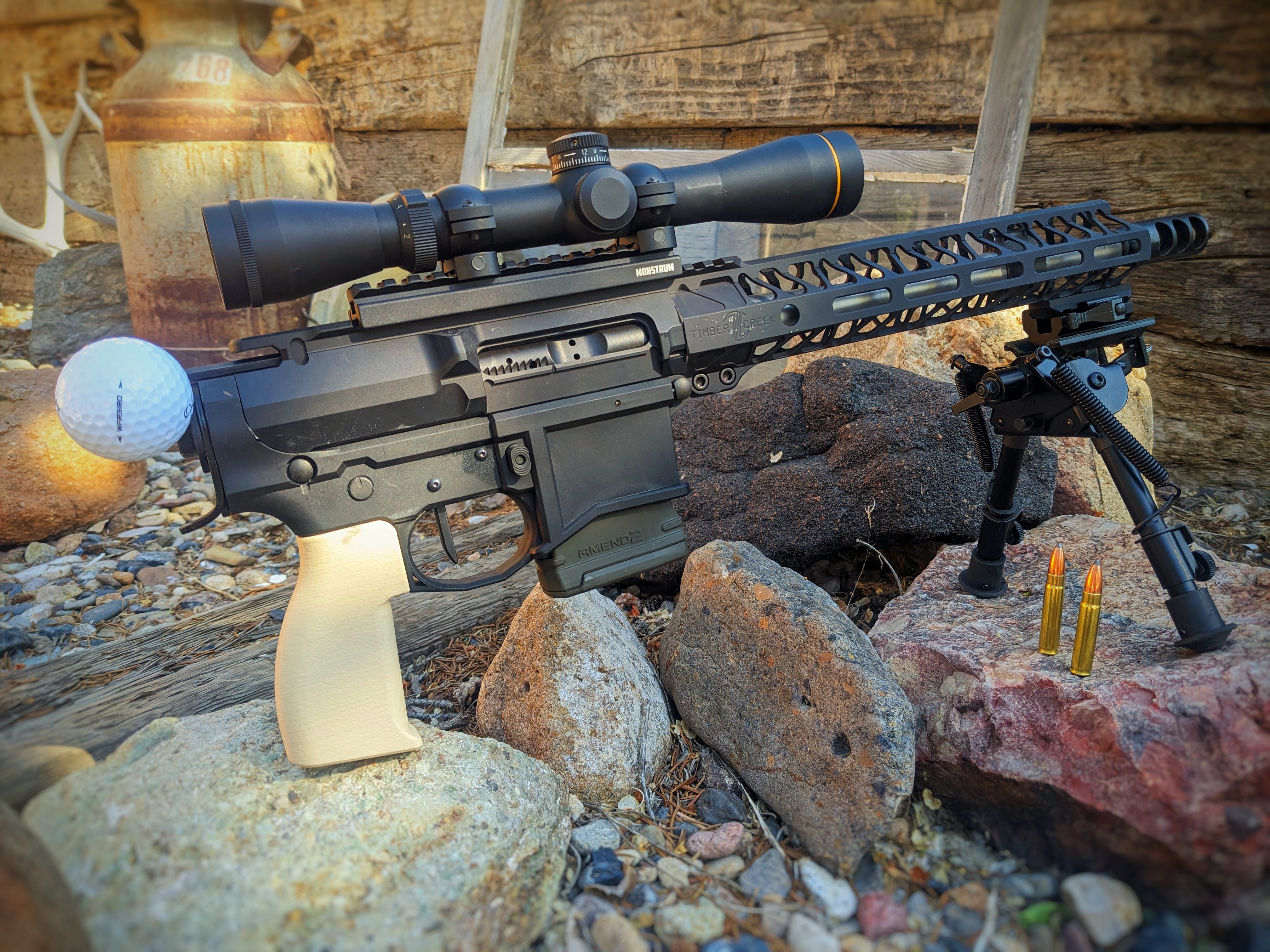
I decided to start with a gun I had built a few years ago, primarily for fun. I built an AR-15 with a polymer lower to replicate the Solo 300 build. If you have never heard of it, the Solo 300 build on an AR looks like the blaster from Star Wars that our smuggler friend Han Solo carries. Which, for the gun nuts out there, is a fancied-up Mauser C96 from World War I. The C96 is a semi-automatic handgun with a magazine forward of the grip. To make a Solo 300, the components that make a semi-automatic rifle in the AR are stripped out and replaced with a bolt handle to run the bolt carrier group. This is done by removing the bolt carrier group, cutting it in half, then flipping the gas key backward, threading the inside of the key, and turning down and threading a long Allen wrench. This then creates a bolt handle that sticks out where the charging handle rides. It takes quite a bit of force to cycle the action, so I added the golf ball at a friend’s request (thanks, Patrick; people are going to lose their minds if they get beaten by a guy with a golf ball glued to his gun).
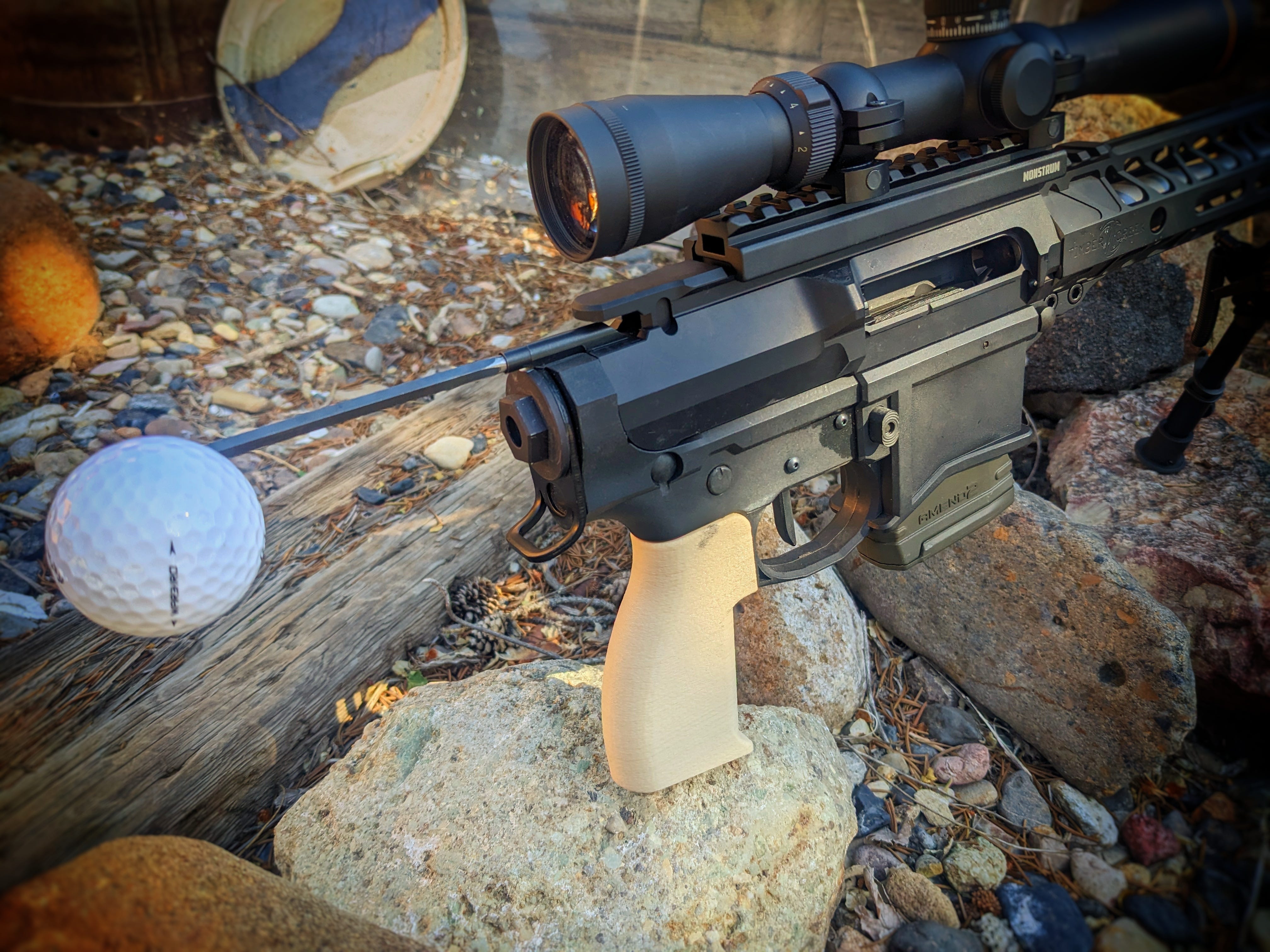
The buffer tube is removed and plugged, and the barrel is cut down below the gas port. In my case, the barrel was in 300 Blackout and cut to 4 inches, producing a little over 1,600 FPS with a 125g bullet. While the fact that it looks like a Sci-Fi gun is fun, it turns out to be a very practical hunting handgun. Barrels and cartridges are easily and quickly changed; the whole thing, especially when built on a polymer AR lower, is relatively light, and unlike other hunting handguns of its size, it can hold a 30-round magazine if you want it to. I choose to stuff ten rounders in it. It hasn’t caught on in popularity, but I really see it as the Thompson Contender for a new generation.
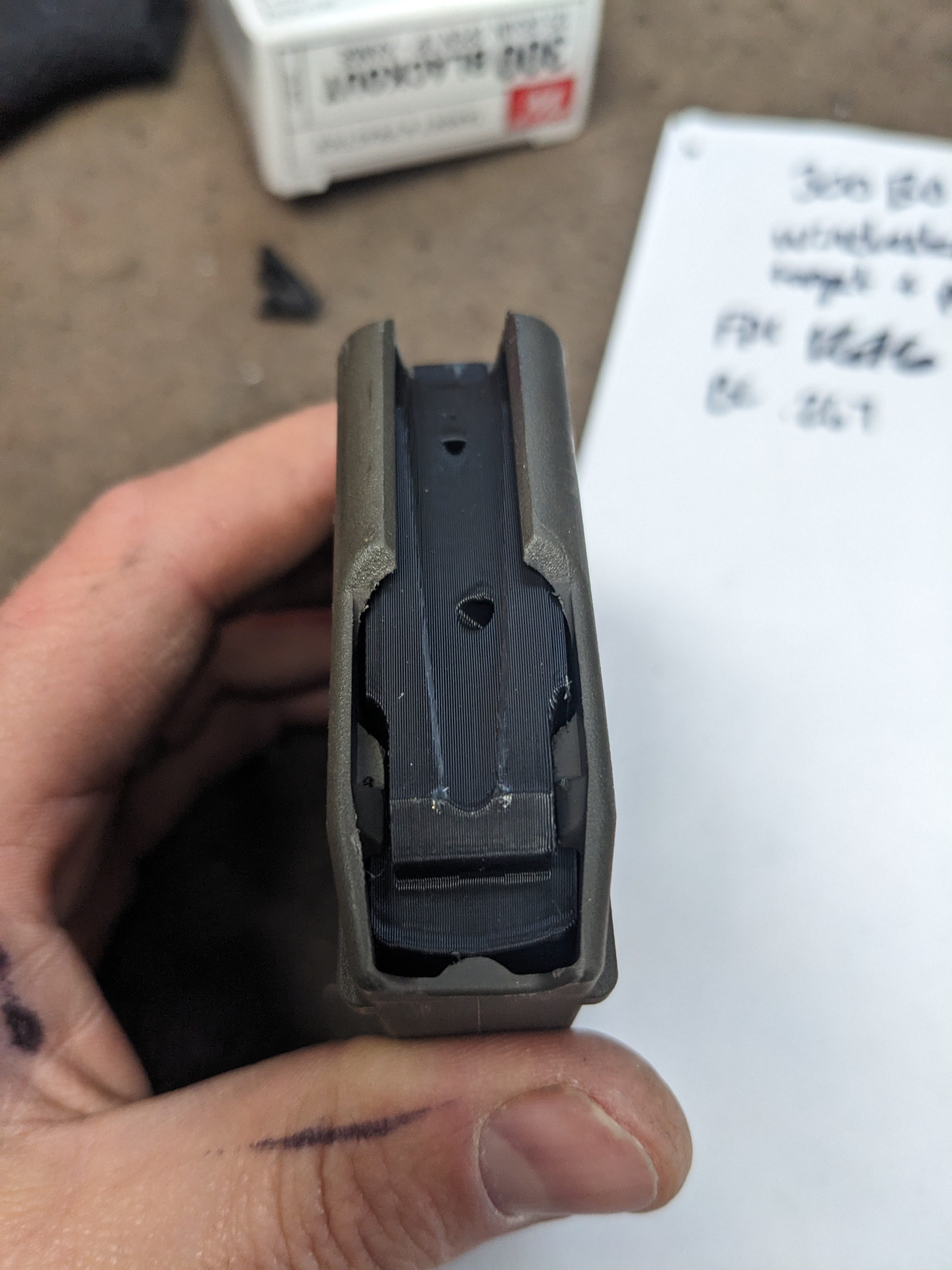
While I had every intention of shooting the little 4-inch 300 Blackout, I knew it would struggle at 400 yards. I mentioned the problem to the same friend from before, and he said, “Why not change it to a 300 Ham’r?” (a cartridge much like the Blackout but designed specifically by Wilson Combat for supersonic velocities). Well, that was a good idea, and it just so happens that I had built myself a 300 Ham’r pistol not long before (article coming soon). Unfortunately, I couldn’t use the 300 Ham’r pistol that I had built in its current configuration. While a short-barreled AR-15 with a pistol brace is considered a handgun by the BATF, the rules of the HHC do not. The competition rules specifically say no buffer tubes and single shots only. Not a problem, I stripped the lower off my Solo build and mated it to the upper of my 300 Ham’r, and voila! I now have a very capable long-range bolt-action handgun. There were two modifications I needed to make, though. First, I removed the adjustable gas block from the Ham’r and replaced it with a spare standard gas block flipped backward. This effectively plugs the gas hole in the barrel, which I no longer needed for bolt-action operation. The second modification I needed was a single-shot follower to replace the moving one in my magazine. Luckily, I found a file for my 3D printer that does just exactly that.
The final modification I made to the lower was a new trigger. The mil spec trigger was not going to cut the mustard for this kind of shooting. I chose a Rise 140 drop-in trigger. I have used these before, and they are a really great trigger for a reasonable price.
There we go, the gun is complete and conforms to the rules of the competition. The only thing I haven’t decided on is running a compensator or my suppressor out on the end of the muzzle. I would love to run the suppressor to keep the muzzle blast to a minimum for myself and the other competitors, but I think I may need to reduce recoil more than a suppressor can. Follow-up shots are a thing in this competition, and seeing my rounds make contact will make a quick follow-up shot much more practical. I have always despised compensators and muzzle brakes. They certainly work to reduce recoil, but they increase the volume of a shot considerably. I can’t stand it, and I have always felt the juice was not worth the squeeze. Especially on a hunting rifle, where, let’s face it, in the heat of the moment, there is no way anyone is remembering to put on their ear protection.
Load development.
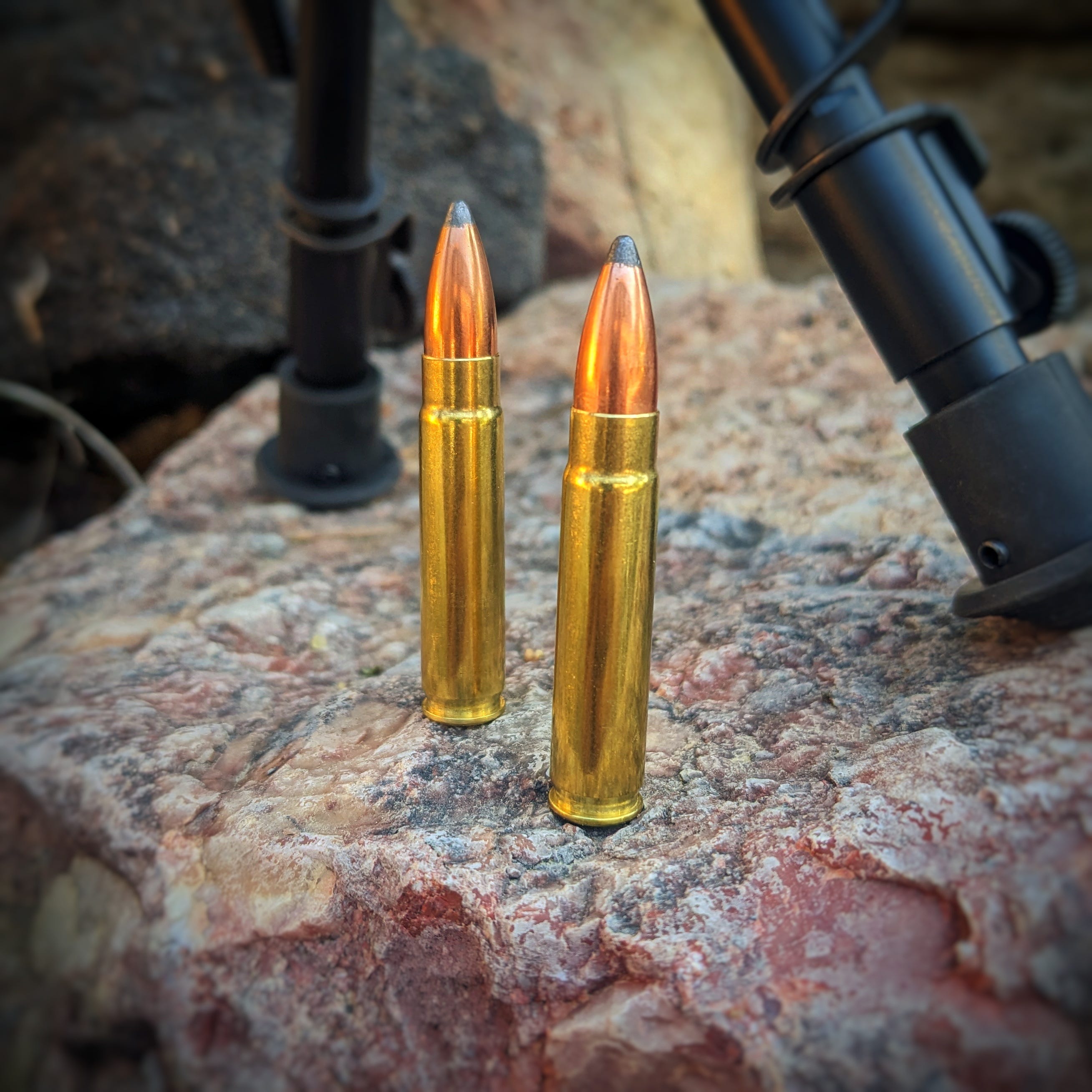
The HHC tournament is shot on a course laid out over natural land, and the targets are AR 500 steel. AR 500 steel targets are expensive, and they want to protect them, so there are restrictions on which bullets can be shot. Those restrictions, on the other hand, are a little confusing to me. They require the use of expanding bullets; FMJs are forbidden, and this makes sense. However, they then go on to forbid hollow-point bullets, all Speer TNTs, and varmint bullets, which makes absolutely no sense to me. Varmint bullets are the most expandable bullets you can find, with Speer TNTs leading the pack. I am assuming the hollow-point ban also extends to ballistic tips, since they are just hollow-point bullets with a piece of plastic stuck in them to fill the hole. So, to follow the letter of the law, I’m going to choose Sierra 125g Soft Point Spitzer bullets. This is technically a varmint bullet and a game bullet. I mean, it’s pretty hard to find a 30-caliber box of bullets that’s less than 150g and doesn’t have the word "varmint" written on it. Anyway, I’m going to show up with the Sierras and see if they kick me out. I will be charging the 300 Ham’r cases with 27g of CFEBLK, which produces a velocity of around 2,217 FPS from my 11.5 inch barrel with the suppressor attached. This load has already produced 100 yard groups for me in the 1.5 inch range with the buffered pistol. With a little load development, I should be able to bring those groups down a little bit more before the competition. Now, as to what I can do with the actual pistol lower will remain to be seen. I rarely attempt a 400-yard shot with a rifle, let alone a gun with no buttstock, but I’m going to give it the ol’ college try.
I have to admit this is not my style of handgun hunting, but it was fun putting a gun together that was out of my wheelhouse. Anytime you try something new, it changes the way you think and makes you a more well-rounded person. I actually like this gun so much that I may just keep it this way after the competition and attempt to go hunting with it. Of course, my performance at the competition may well be the determining factor whether I change it or not, and if I do poorly in the competition… Well then, we never discussed this.
I need to read up on the .300 HAMR. I own and shoot the Blackout, but this one is new to me.
That gun sounds absolutely insane. I mean "insane" as in "a person that starts fights with decorative trees". Wish I could try that pistol out. Have fun at the competition.