
The HHC Rimfire

There is nothing better than rimfire. So when I signed up for the “Handgun Hunters Competition” in Newcastle, WY, I was excited to see there was a rimfire class. Truth be told, I am most excited for the rimfire class. When it comes to building guns for myself, rimfires have long been a staple in my shop. They are fun, accurate, and most importantly, they allow us as shooters and hunters to get out into the field without breaking the bank. I am quite frugal by nature, and as much as I love shooting my big bore revolvers, pissing away 50 rounds of hard-earned hand-loaded ammunition on anything but live animals gives me anxiety, rimfire not so much. So when the nice lady asked me what classes I wanted to shoot in for the competition, I, of course, said all of them, but between you and me, I’m very excited about the rimfire class.
Choose wisely.
Now that I was signed up, it was time to choose a gun to shoot. I have many rimfires that would be a hoot to use in the competition. My eight-inch Smith & Wesson Model 17 was a strong contender. Highly accurate and with such a long sight plane, I can take cottontails off-hand at 50 or so yards. I also have a Smith 17-8, blued with a full underlug and an aluminum cylinder that I am quite fond of, and you have all seen my Browning Challenger, easily my most accurate semi-auto handgun. I really wanted to shoot something in each class that I had built, or at least worked on. I also really want to do my best in this competition, so I looked up the class rules and decided to get as close to the limits as possible. According to the HHC rules, the rimfire class handgun must have a barrel of less than 10 inches, be chambered in 22 LR, and is allowed to have an optic as long as it is not a rifle scope.
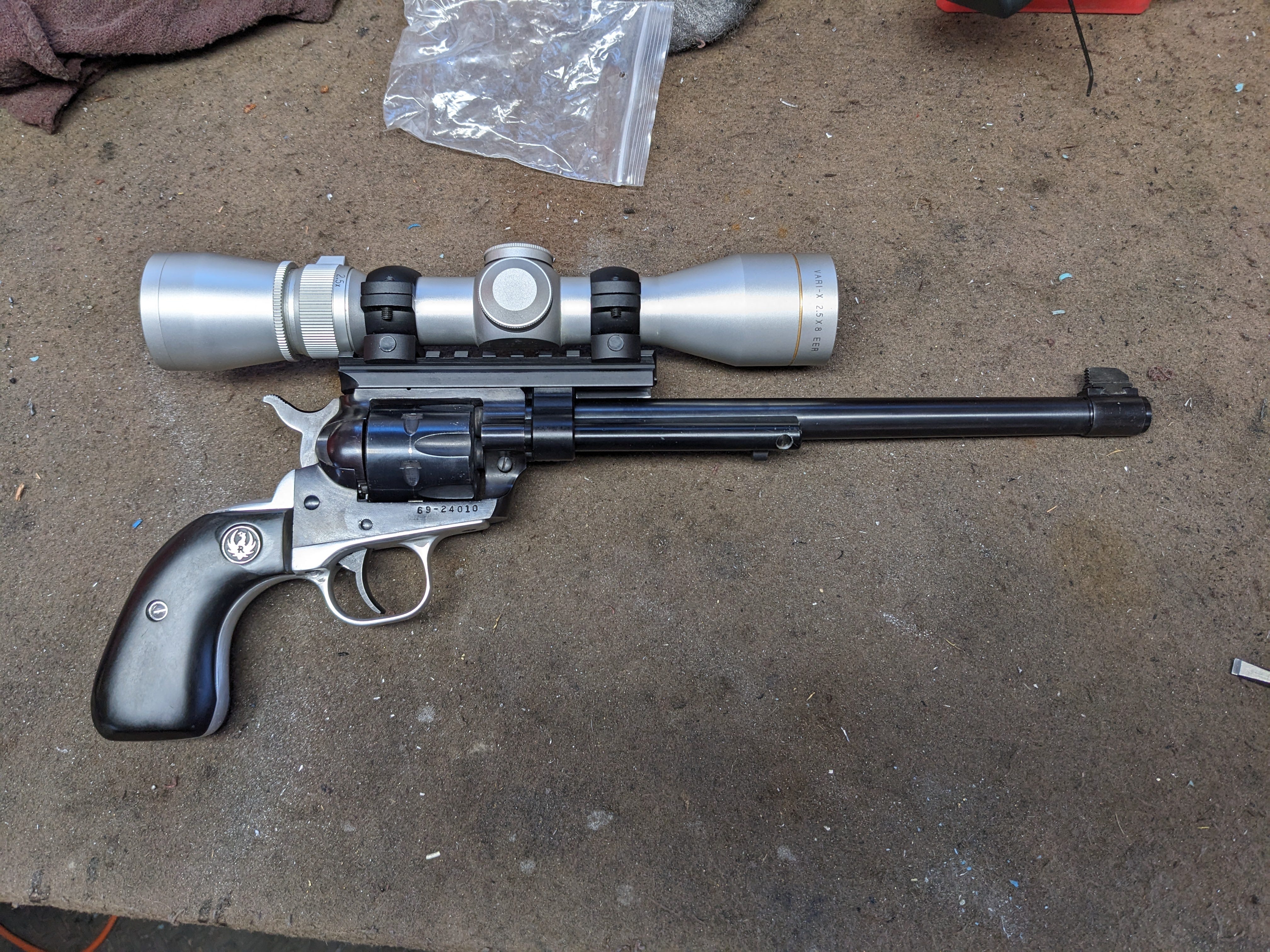
Ok, I can work with that criteria. I poked around in my safe and found the perfect gun. A few years ago, I built myself a Ruger Single Six. This is not your ordinary Single Six, though. I replaced the barrel with an old cut-down Ruger 10/22 barrel. At 9 ¾ inches, it was just short enough to make the competition. I have dual cylinders for this gun, and the .22 Magnum chambering shoots better, but for the competition, I must use .22 LR. I have always shot this revolver with iron sights, and it is very accurate. After reading the literature for this competition, though, I decided scoping it was my best chance to be competitive in this class. I went online and ordered a Weig-A-Tinny scope mount. ( https://jackweigand.com/ )These are a great option for anyone wanting to scope a Ruger revolver. They come with a small clamp that slips over the barrel and the ejector rod housing, creating a base to screw the front of the Pic rail to. This allows anyone with a Ruger to install a scope rail without drilling and tapping holes. If you do use one, be warned that there are a lot of set screws to make this contraption work, so on anything but a rimfire, blue Locktite is going to be your best friend. That being said, I have always been impressed with this scope mount and have used several over the years with good success.
After the rail was mounted, I snuck over to the safe and “borrowed” a Leupold 2-8 variable handgun scope from a Smith & Wesson 44 Magnum I own. That should allow me to easily reach out and touch some of the longer targets. I’m pretty good with iron sights on a handgun, but with many targets being well over a hundred yards, I will need all the help I can get, and the scope will help considerably.
We’ve got a shooter.
Now that my weapon was set up the way I liked it, I needed to find the best load for it. Personally, I have always shot Federal American Eagle 38g hollow points. They have always been reasonably priced and seem to shoot well in just about every gun I put them in, and I have thousands on hand. This revolver is no different. I already knew it shot the Federals well because that is what I had been shooting squirrels and rabbits with. This competition, though, is going to require that I ring out every drop of accuracy I can get. So, I went to my ammo shelf and gathered up every single brand of 22 shell that I had that I knew I had enough to compete with, and headed out to the range. I won’t bore you by listing every brand of ammo I shot, but I will fill you in on the top performers and include images of my targets so you can see for yourself. All targets were shot from a bench at 25 yards. It was cold at 30 degrees, so expect all recorded velocities to be a touch higher on a normal summer day. Eighteen rounds were fired with each brand of ammo.
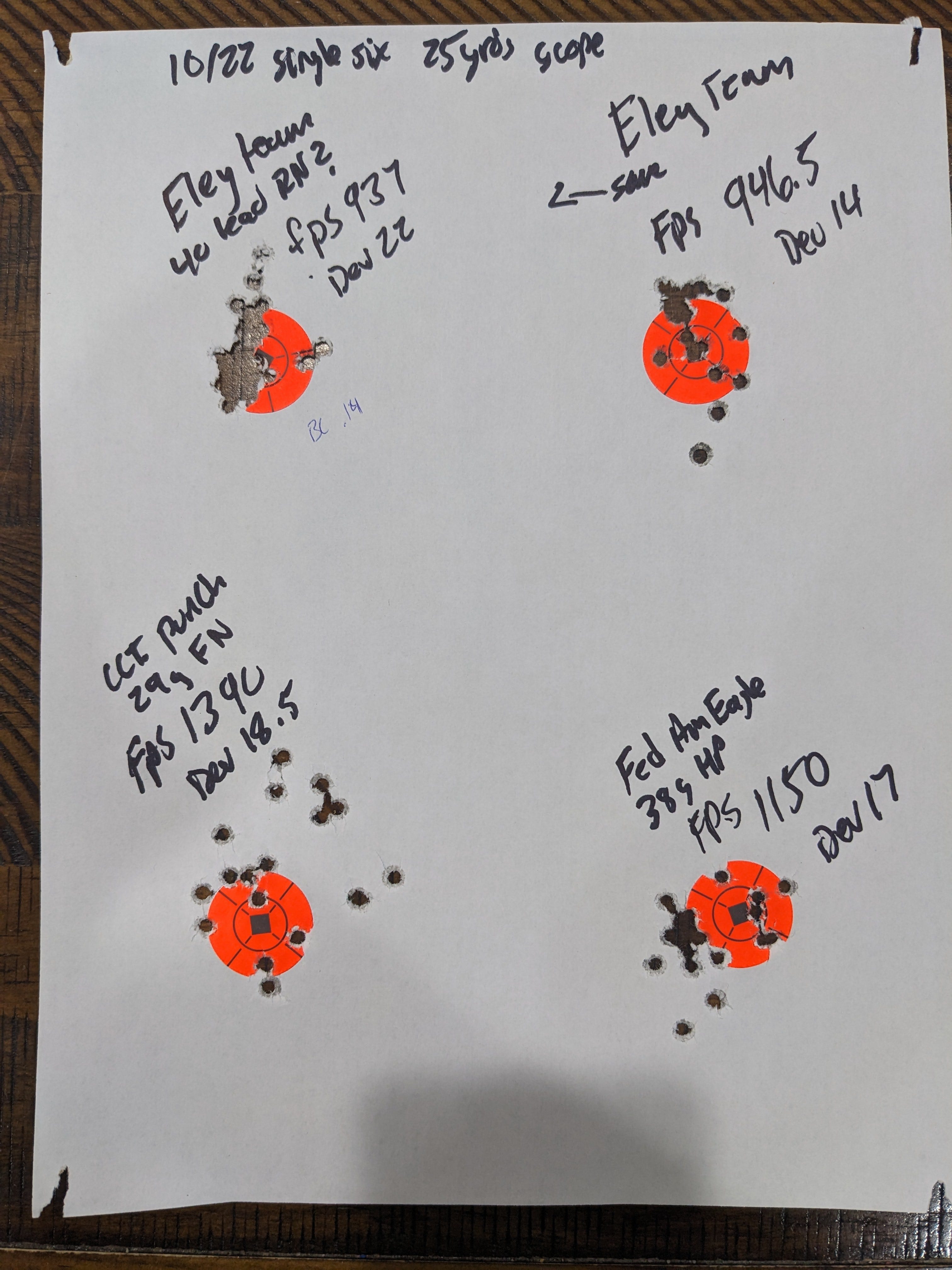
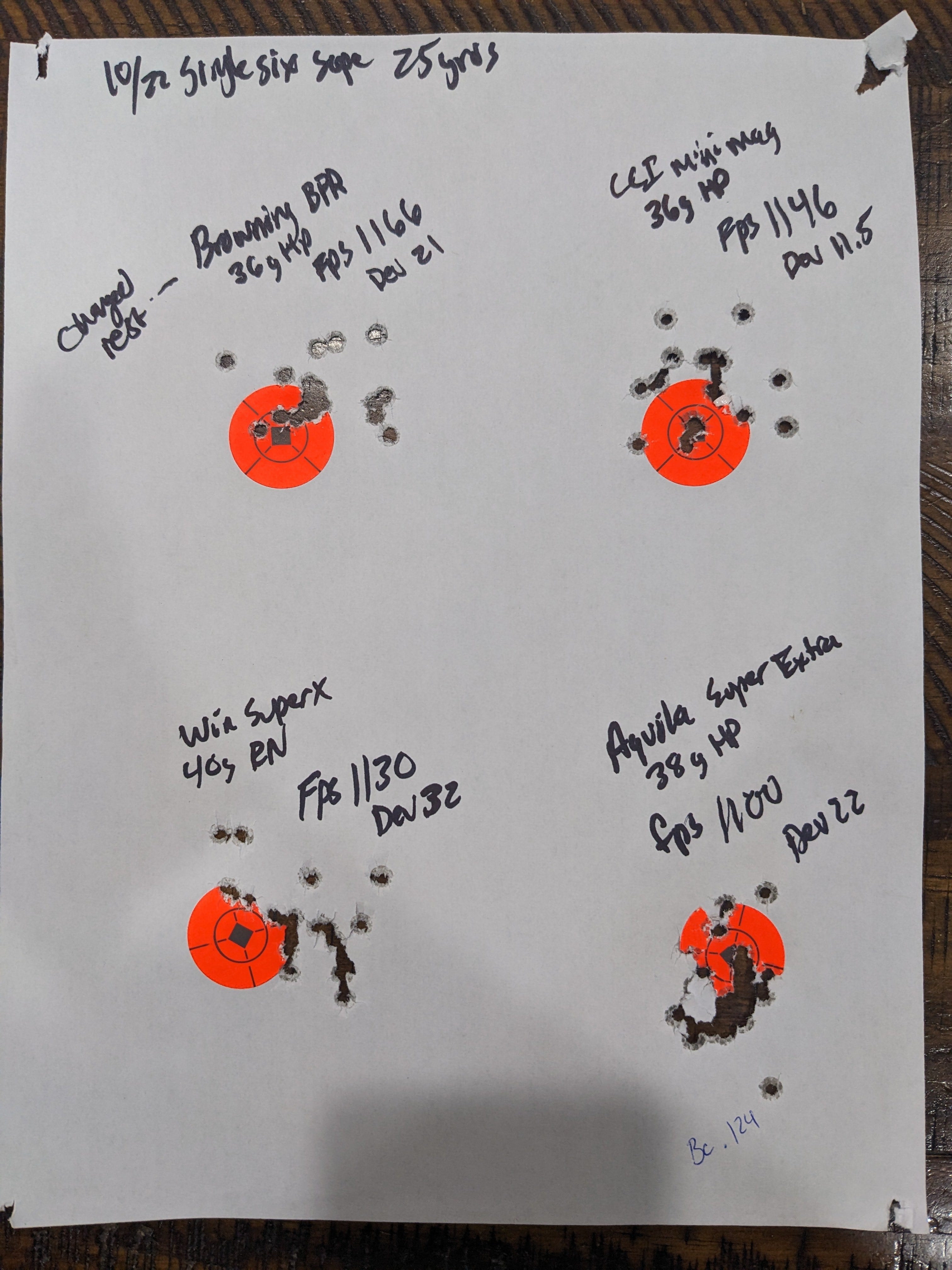
As expected, ol’ reliable, the Federal American Eagles performed well, better than most, and incidentally, when you can find it, it is half the cost of anything else I tested. So they will be a staple 22 shell for me for many years to come, but I did find two brands that performed even better. The first was Aguila 38g hollow points, and the second was Eley Team. The box didn’t have the info on it, but I am guessing it’s a 40g lead round nose. Both shot one ragged hole with a handful of flyers; undoubtedly, some are my shooting, some are goofy ammo as 22 shells tend to do, and I may also have a charge hole in my cylinder that is not as good as the others. As you can see, every group seemed to have 3-6 rounds that just wouldn’t cooperate.
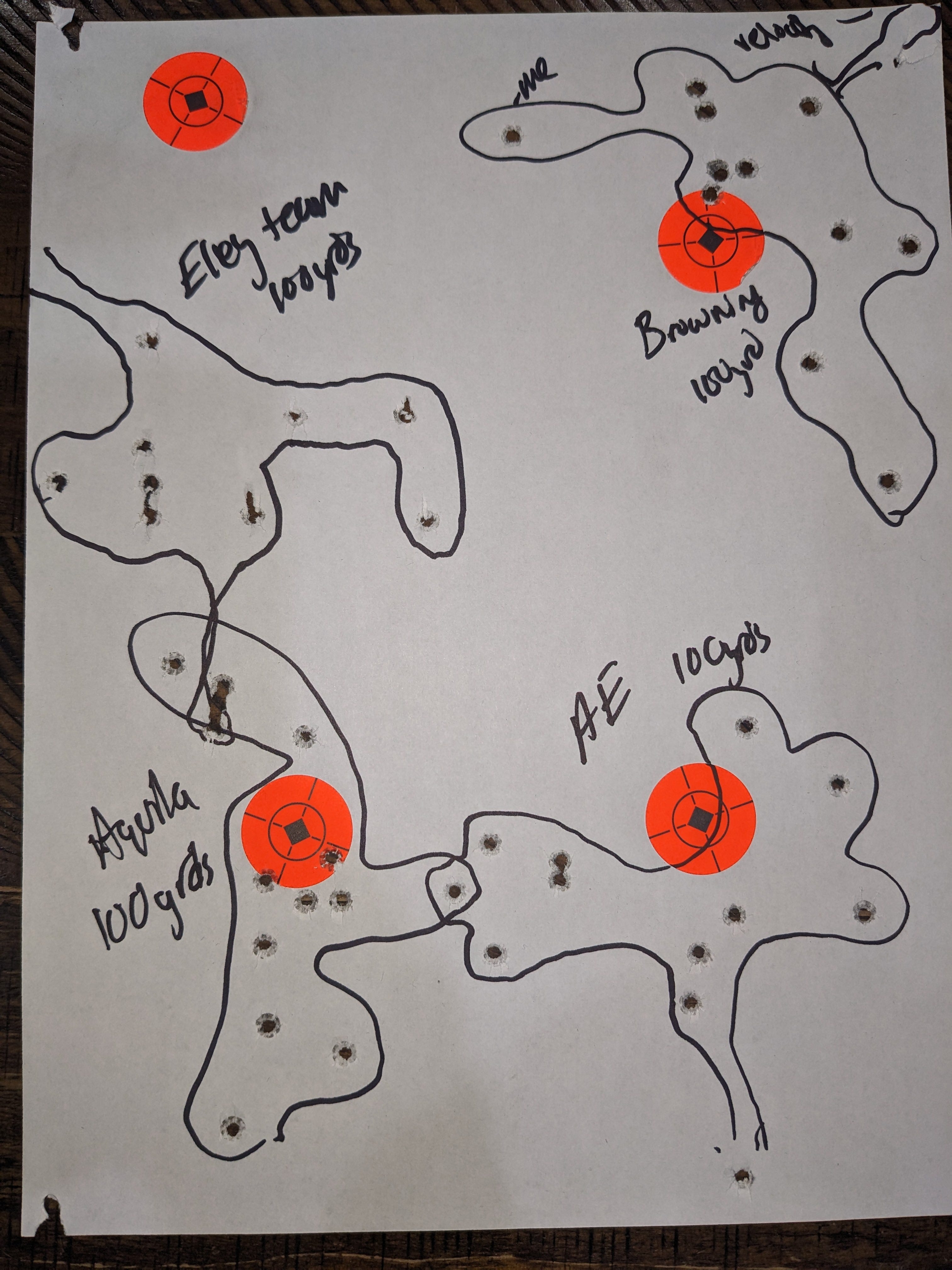
Now that I had my top performers at 25 yards, it was time to stretch them out farther. I went back to the range with the top performers, plus one extra that I felt needed another look. Results were fascinating, and prove that you really don’t know what a bullet is going to do until you actually shoot it. It turns out that at 100 yards, most of the differences between the rounds seemed to iron out. All groups were right at the 3” mark, counting the wacky flyers. Truly, I could shoot any of the ammo choices and probably see no difference in my performance in the competition, but as you can see from the picture, the Aguila offering had very little left- and right-stringing. I like that. I would prefer vertical variation over horizontal. I think that will cause me less grief when I am making wind calls during the competition. If I have one weakness going into this competition, it is compensating for the wind.
Now that I have chosen my ammo, I just need to make myself a drop card, and I am ready for the competition. I am really shooting most of this match for fun, but I really want to show well in the rimfire class. I shoot a lot of rimfire in my day-to-day life, and I will be very disappointed if I come out at the bottom of the heap, but I also have no idea what to expect as far as competition goes. Keep your fingers crossed for me, and I’ll see you in Wyoming.
I have a S&W Model 17-4 with a 8 3/8" barrel I bought new in the '70s. It's the most accurate hand gun I've ever shot. I had a target trigger & target hammer put on it by a gunsmith right after I got it. It's one I'll never sell.
That custom Single Six is so cool! Also, thanks for the heads up on Weig-a-tinny. I had never heard of them before.